You May Also Like
In Transit Package Available for Clearance: What It Means and What to Do Next
Shipment at Local Distribution Center: What It Means and What to Do Next
For Customs Clearance, What Is Prepared by the Exporter? (Complete Checklist)
Bill of Lading and Air Waybill: Differences, Uses, and Which One to Use in India
Courier Charges in India Per Kg (2026): Domestic and International Rates Explained
Freight Forwarder China to India: Costs, Process, and How to Pick a Reliable One
Bill of Lading and Air Waybill: Differences, Uses, and Which One to Use in India
By International Shipping Cargo Agency in Delhi | Updated October 2026
It can feel like a lot of paperwork when you are shipping your first shipment. Two papers keep coming up. One is for sea cargo; one is for air cargo. They look similar, but they work quite differently. If you mix them up, it can stop your payment, slow down customs clearance, or leave your cargo stranded at the port.”
This guide explains the bill of lading and air waybill in simple words with examples from Indian trade. In the end, you’ll understand what each document does, who issues it, and which one is right for your shipment.
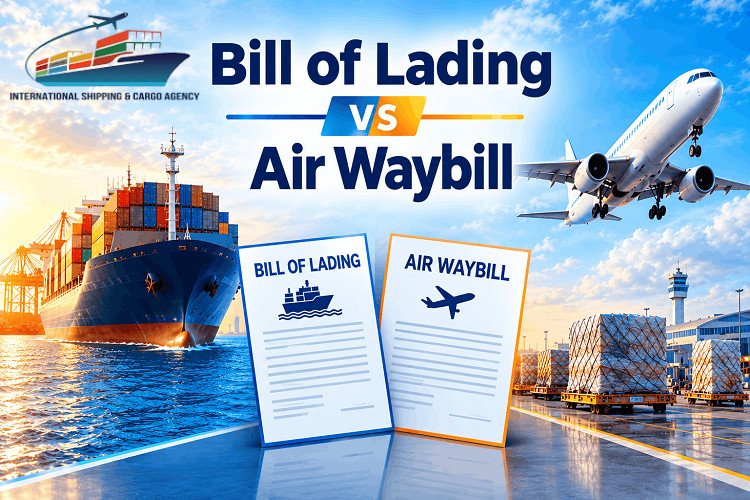
Bill of Lading vs. Air Waybill
Quick Answer: Sea freight uses a bill of lading (BL). It is a receipt, a contract of carriage, and in its negotiable form, a document of title. Air freight uses an air waybill (AWB). It is both a receipt and a contract, but not a document of title, and so it cannot be sold or transferred by endorsement.
To summarise, both the bill of lading and air waybill are evidence of cargo being delivered to a carrier. The main difference is that a BL can state who is entitled to the goods, whereas an AWB can only state who will be the receiver.
What Is a Bill of Lading? (Bill of Lading Meaning)
The meaning of the bill of lading is pretty straightforward – it’s a document issued by the shipping line or a freight forwarder acting as a carrier after your cargo is loaded on a vessel. It says that the goods have been received and will be delivered to the party named at the destination port.
A BL does three things:
- Receipt: it indicates the quantity, packing, and condition of goods as received by the carrier.
- Contract of carriage: it contains the terms under which the cargo is transported
- Document of title: The person who holds the original BL can claim the cargo in negotiable form. That is why they ask banks for this in the form of a letter of credit.
Common types you will see in India are:
- BL Straight: to the named consignee only. It’s non-negotiable.
- Order BL: It can be transferred by endorsement and is often used in bank-financed transactions.
- Sea waybill/telex release: no original paper is needed, which speeds up release at destination.
- Clean and closed BL: a clean BL has no comments about damage, while a closed BL records a problem with cargo or packing.
What Is an Air Waybill? (Air Waybill Meaning)
Just as simple is the meaning of an air waybill. It is a non-negotiable document issued by an airline or its authorised cargo agent for goods carried by air. It indicates the shipper, consignee, airport of departure and destination, description of goods, weight, and freight charges.
All AWBs have an 11-digit number. The first three digits are the airline, and the next eight are the serial number. You can use this number to track your cargo on the airline’s website.
As an AWB is not a document of title, the airline will deliver the cargo to the consignee named on it. There is no requirement to submit an original paper at destination, which maintains the rapid movement of air cargo. Many airlines also use an electronic AWB (e-AWB) to reduce the amount of paperwork.
House BL vs Master BL (and HAWB vs MAWB)
House BL vs master BL is a question many first-time shippers struggle with, so here’s the simple explanation.
- Master BL (MBL): issued by the shipping line to the forwarder who booked the space. The forwarder appears to be the shipper.
- House BL (HBL): This is the bill of lading that the freight forwarder issues to you, the real exporter. It shows the genuine shipper and consignee.
This is typical on LCL shipments, where multiple exporters’ cargo share one container. Each exporter receives one master bill of lading from the line and a house bill of lading from the forwarder.
The split is the same for the bill of lading and air waybill. In air freight, the Master Air Waybill (MAWB) is issued by the airline, and the House Air Waybill (HAWB) is issued by the forwarder. Always check which one you are getting. Make sure names and addresses are correct.
Difference Between BL and AWB
Here is a side-by-side comparison of a bill of lading and an air waybill. This is the fastest way to see the difference between BL and AWB.
Point | Bill of Lading (BL) | Air Waybill (AWB) |
Mode of transport | Sea | Air |
Issued by | Shipping line or forwarder | Airline or authorised agent |
Document of title | Yes, in negotiable form. | No |
Negotiable | Yes (order BL) | No |
The original is needed to release cargo. | Usually yes, unless it’s a telex release or sea waybill | No |
Number format | Carrier-specific, letters and digits | 11 digits |
Transit time | Weeks | Days |
Master and house forms | MBL and HBL | MAWB and HAWB |
The takeaway is the title. A BL can be endorsed, and so can transfer ownership of goods even before the goods are landed. An AWB can’t.
AWB vs BL in Export: Which One Do You Need?
AWB vs BL in export mainly depends on your cargo and your deadline. The choice between a bill of lading and air waybill is really the choice between sea or air freight.
- Sea Freight (BL) is the right choice for heavy, bulky, or low-value-per-kg cargo such as machinery, textiles in bulk, or auto parts. Many Indian exporters ship out of ports such as Nhava Sheva, Mundra, or Chennai.
- Air freight (AWB) is ideal for urgent, high-value, or time-sensitive goods such as samples, electronics, pharma, or fresh items. IGI Airport is often used by Delhi exporters for this.
The key trade-offs are cost and time. Air is faster but more expensive per kg. Sea freight is slower but much cheaper for large volumes.
Payment terms matter, too. Should your buyer pay by letter of credit, the bank will check your BL or AWB against the LC and the invoice. Even a slight misspelling of the consignee name may be seen as a discrepancy and delay your payment.
Shipping Documents in India: What Goes With the BL or AWB
These two documents are never going alone. In India, the shipping documents usually contain the following.
For exports:
- INVOICE
- List of Items to Pack
- Shipping bill filed with Indian Customs through ICEGATE
- BL or AWB
- Certificate of origin, if required by the buyer or the destination country
- Insurance certificate, if the cargo is insured
- GST papers like LUT or IGST payment details
- Importer Exporter Code (IEC)
For imports, you will need the Bill of Entry, the BL or AWB, the invoice, the packing list, and your IEC. The Indian Customs cross-checks the details across these papers, so the consignee name, goods description, quantity, and weight should be consistent throughout.
Rules and forms may change over time, so check with your customs broker or freight forwarder for the current requirements before you ship.
Common Mistakes to Avoid
Errors in these papers are one of the most frequent causes of delay. Look out for these:
- Wrong consignee details: A wrong name, address, or phone number can prevent delivery.
- Goods description mismatch with the invoice: This can lead to questions from customs and the bank.
- Don’t get the draft checked: Once the final BL is issued, changes take time and cost money.
- HBL and MBL confusion: Know what document your bank and buyer are expecting.
- Release instructions ignored: The original BL is not surrendered, or the Telex Release is not done. Cargo cannot be released at the destination.
- Weight or quantity mismatch: means additional charges or inspection.
Practical Tips Before You Ship
Remember these simple steps before you finalise your BL or AWB:
- Request a draft BL or AWB and confirm all details with the invoice and packing list.
- Confirm the Incoterms with your buyer so you’ll know which costs belong to them and which to you.
- Ask your forwarder if the BL will be a set of originals, telex release, or sea waybill.
- Keep scanned copies of all the documents safe.
- Provide the BL or AWB number early to your buyer so they can track the cargo.
Final Thoughts
Knowing the bill of lading and air waybill can save you costly delays. Keep it simple: a BL is for sea freight and can be a document of title; an AWB is for air freight and only names the receiver. Double-check all details before release of documents, and keep the invoice, packing list, and shipping papers consistent.
Looking for help with a bill of lading and air waybill for your next shipment? International Shipping Cargo Agency in Delhi can guide you on documents, sea and air freight, and customs clearance formalities. Get a free quote from our team or visit internationalshippingcargo.com.
Frequently Asked Questions (FAQs)
BL is used for sea freight and can be a title document. AWB is used for air freight and is not a document of title.
No. An AWB only states the consignee. You can’t buy it. You can’t sell it.
No. A BL is for transport by sea. Air cargo travels on an air waybill.
On the whole, yes, for an original BL. A sea waybill or a telex release does not require the original paper.
The house BL is issued to the exporter by the freight forwarder. The master BL is issued to the forwarder by the shipping line.
Nope. The AWB number is an 11-digit cargo tracking number. The aircraft has a flight number.
One Response