You May Also Like
In Transit Package Available for Clearance: What It Means and What to Do Next
Shipment at Local Distribution Center: What It Means and What to Do Next
For Customs Clearance, What Is Prepared by the Exporter? (Complete Checklist)
Bill of Lading and Air Waybill: Differences, Uses, and Which One to Use in India
Courier Charges in India Per Kg (2026): Domestic and International Rates Explained
Freight Forwarder China to India: Costs, Process, and How to Pick a Reliable One
For Customs Clearance, What Is Prepared by the Exporter? (Complete Checklist)
Written by the team at International Shipping Cargo Agency in Delhi. Established in 2007, with 18+ years of experience in import-export documentation, customs clearance, and sea and air freight from India. Office: Connaught Place, New Delhi. Last reviewed: October 2026.
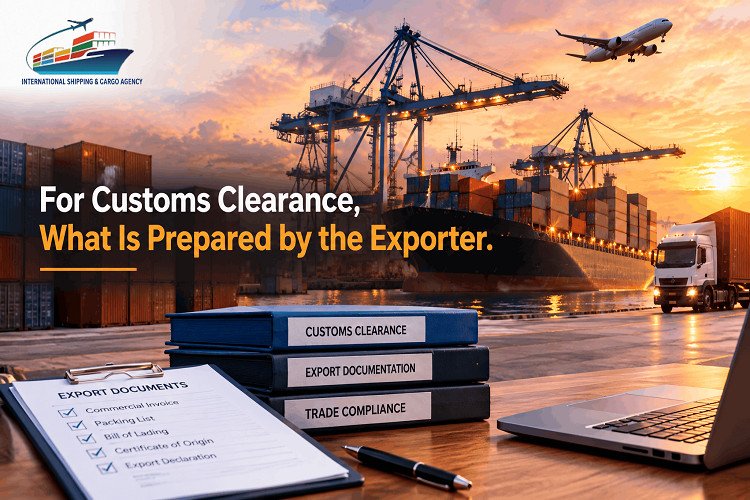
If you are sending goods abroad for the first time, one question comes up quickly: for customs clearance, what is prepared by the exporter?
The short answer is as follows. The exporter fills out the commercial invoice and the packing list and details the shipping bill. In addition, the exporter arranges supporting papers like a certificate of origin, GST documents, and any product-specific permits. The transport document (bill of lading or air waybill) is on the carrier side. The importer deals with the paperwork at the destination.
A small mistake in these papers can tie up your cargo for days in the port or airport. This guide explains each document in simple words, so you know what to prepare, who files what, and what to check before the cargo leaves your warehouse.
Quick Answer: Documents the Exporter Prepares
- Invoice of Lading
- What to bring
- Shipping bill (submitted by you or your customs broker on ICEGATE)
- Certificate of Origin (if required by buyer or country of export)
- Proof of payment of IGST (LUT or IGST papers)
- Copy of export contract, purchase order or letter of credit.
- Certificate of insurance (conditions of sale apply)
- Product-specific certificates, e.g., quality, health or plant certificates
What Is Customs Clearance in Export?
Export customs clearance refers to the procedure in which Indian Customs examines your goods and documents and allows the cargo to leave the country. The officer checks that the goods are the same as those in the documents and that the export is permitted and the declared value and classification are correct.
When everything is in order, Customs gives “Let Export Order” (LEO). Only then can the carrier load your cargo onto the ship or flight.
Registrations You Need Before Preparing Documents
Before the papers, you need to have a few basic registrations ready:
- IEC (Importer Exporter Code): DGFT-issued. You can’t export commercially without it.
- AD Code Registration: The authorised dealer code of your bank needs to be registered with Customs on the ICEGATE portal for filing of Shipping Bills.
- GST registration and LUT: Exports are zero-rated under GST. You can issue a Letter of Undertaking (LUT) every financial year and export without IGST. Alternatively, you can pay IGST and claim a refund.
- RCMC: registration with the relevant Export Promotion Council, which helps you claim certain benefits for export.
Documents Prepared by the Exporter for Customs Clearance
Here is the detailed list. This is the core answer to what is prepared by the exporter in India.
1. Commercial Invoice
This is the principal document of the sale. It shows buyer and seller details, product description, HS code, quantity, unit price, total value, currency, and the terms of sale (Incoterms such as FOB or CIF). It is used by customs to check the value of goods. The description must be identical, word for word, to your other papers.
2. Packing List
The packing list shows the contents of each box: number of packages, gross and net weight, dimensions, marks and numbers. It supports the customs officer at the time of physical examination and helps the buyer to verify the cargo at arrival. The weight and number of packages should match the invoice and shipping bill.
3. Shipping Bill
The shipping bill is the principal export declaration in India. The same is filed electronically on ICEGATE either by the exporter or by an authorised customs broker (CHA) on behalf of the exporter. Details are taken from your invoice and packing list. Depending on the type of goods, it can be a free, dutiable, or drawback bill of lading. Once filed, Customs can inspect the cargo and issue the LEO.
Not sure which documents your product needs? Our team can review your papers before shipment. Contact us.
4. Certificate of Origin
The country where the goods were produced. It is requested by some buyers and countries and is required for claiming lower duty under many trade agreements. It is applied for by the exporter and issued by an authorised agency such as a chamber of commerce or an export promotion body.
5. Export Contract, Purchase Order and Letter of Credit
The deal is backed by the buyer’s purchase order or the sales contract. If payment is by Letter of Credit, documents have to be exactly as per the LC terms. Even the slightest mismatch could cause a delay in payment from the bank.
6. Insurance Certificate
If you are selling on CIF or CIP terms, the exporter arranges cargo insurance. The buyer normally does this on FOB. Check your terms of sale before the shipment.
7. Product-Specific Certificates
Some products need extra papers. Certain food products might require a health or quality certificate; plants and seeds require a phytosanitary certificate, and some chemicals or controlled goods require permits or no-objection letters. These certificates can take time, so check the rules for your product and the country you’re sending to in good time.
Documents the Exporter Does Not Prepare
This is where many new exporters get confused. Some important shipping documents in India are not prepared by the exporter:
- Bill of Lading or Air Waybill: issued by the carrier or freight forwarder. The exporter gives correct shipping instructions only.
- Bill of Entry: filed by the importer in the country of import.
- Export Order: Issued by Indian Customs post-clearance.
Bill of Lading Meaning
The meaning of a bill of lading is very simple. It is the document issued by a shipping line or its agent for sea cargo. It is a receipt for the goods. It is a contract of carriage. It is a document of title. It is made “to order” and can be transferred, so the buyer will often need the original to collect the cargo.
For a deeper comparison, read our guide on bill of lading and air waybill.
Air Waybill Meaning
An air waybill is not too different in meaning, but for air cargo. Issued by the airline or its agent. It is a receipt and a contract of carriage. It is not a document of title and is not negotiable. Every AWB is assigned an 11-digit number: 3 digits for the airline code and 8 for the number.
Difference Between BL and AWB
The difference between BL and AWB is easy to see in a table:
Point | Bill of Lading (BL) | Air Waybill (AWB) |
Mode | Sea | Air |
Document of title | Yes. | No |
Negotiable | Can be, if made “to order”. | No |
Originals | Usually a set of 3 originals | Original copies, but not needed to claim cargo |
Issued by | Shipping line or forwarder | Airline or forwarder |
The practical point is delivery by AWB vs BL in export. The buyer needs the original to collect the cargo with a BL. An AWB means the cargo is released to the named consignee, so there is no title to transfer.
House BL vs Master BL
The question of house BL vs master BL comes up when you are shipping through a freight forwarder. The forwarder (or consolidator) is issued the master BL by the shipping line. The forwarder will give you the house BL, the actual shipper. The house BL has your name and your buyer’s name on it. The master BL has the details of the forwarder. Air cargo with a house AWB and a master AWB follows the same pattern.
Export Documents Checklist
Document | Prepared by | Used for |
Commercial invoice | Exporter | Value and description |
Packing list | Exporter | Cargo details and examination |
Shipping bill | Exporter or CHA | Customs declaration |
Certificate of origin | Exporter applies, agency issues | Duty benefits, buyer’s request |
GST LUT or IGST proof | Exporter | Tax compliance |
BL or AWB | Carrier or forwarder | Transport and delivery |
Bill of entry | Importer | Import clearance abroad |
Common Mistakes That Delay Customs Clearance
- The invoice, packing list, and shipping bill contain different product descriptions.
- The HS code is missing or incorrect.
- Weight or piece count does not match in the documents.
- LUT or IEC, AD code details missing.
- Late application for certificate of origin or product permit.
- Values not in accordance with the Letter of Credit terms.
Practical Tips Before You Ship
- Most of the delays we see at the International Shipping Cargo Agency in Delhi are because of small mismatches and not big problems. A few habits help.
- First, make out the invoice, and then copy the exact details of it on every other paper.
- Get your customs broker to confirm the HS code before you file.
- Ask your buyer early on if they need a certificate of origin or any special certificate.
- Keep scanned copies of all documents, and have a few extra printed copies.
- Write your shipping instructions to the forwarder so the BL or AWB is correct on the first draft.
Rules and procedures may change. Always check the latest requirements on the ICEGATE, DGFT, and CBIC websites or with a licensed customs broker before you file.
Conclusion
To sum up, the answer for customs clearance is that what is prepared by the exporter is a set of matching documents: the commercial invoice, packing list, shipping bill, and the supporting certificates your product and buyer need. The BL or AWB comes from the carrier, and the Bill of Entry is the importer’s job. Keep every detail consistent across papers, and your clearance will be much smoother.
Need help with your export documents? Contact the International Shipping Cargo Agency in Delhi for a free consultation and quote. Our team can inspect your papers before despatch and assist you with sea and air cargo and customs clearance.
Frequently Asked Questions (FAQs)
The exporter prepares the commercial invoice, packing list, shipping bill details, and supporting papers like certificate of origin and GST documents.
The exporter or an authorised customs broker files it electronically on ICEGATE.
No. It is issued by the carrier or the freight forwarder as per the instructions of the exporter.
No. The certificate is only required if the buyer, the destination country, or a trade agreement requires it.
Not for commercial export. An IEC is a basic requirement.
3 Responses