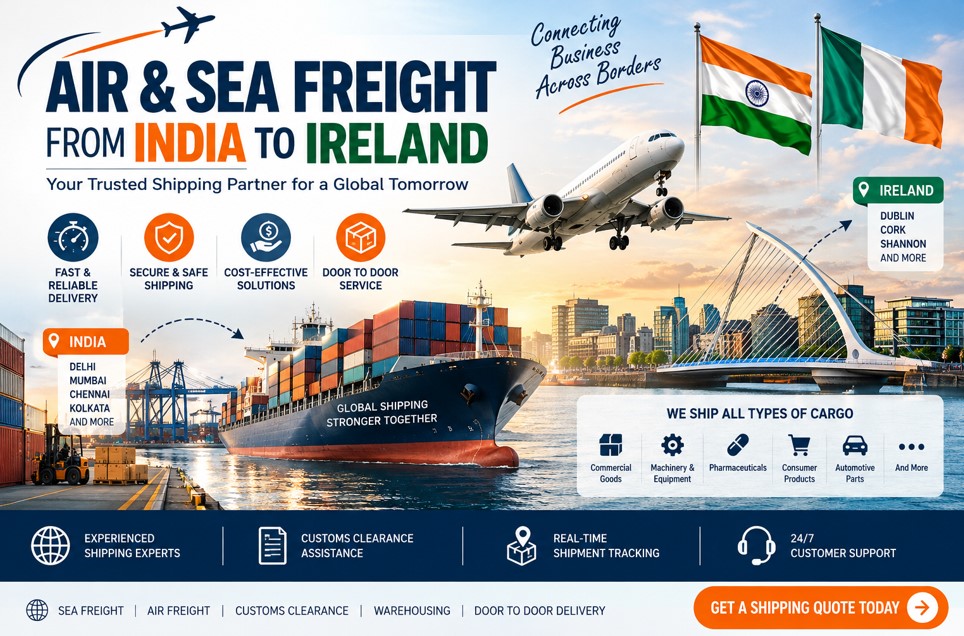
Air & Sea Freight from India to Ireland

If you run a business that exports to Europe, Ireland is not a market you can ignore. It is home to global pharmaceutical, medical device, and technology companies, and Indian exporters increasingly supply raw materials, textiles, machine parts, and finished goods into this small but wealthy economy. But before you book a shipment, you need clarity on one core decision: air freight or sea freight?

This guide breaks down everything about air & sea freight from India to Ireland — the real transit times, the honest cost ranges, the customs paperwork, and the practical route your cargo actually travels (spoiler: there is no direct flight, so routing matters more than most people realize). Whether you are shipping a single pallet or a full container, this page will help you plan with confidence instead of guesswork.

Contact Form

Why Ireland Matters for Indian Exporters

Ireland is a small island nation, but it punches far above its weight in global trade. It hosts nine of the world’s ten largest pharmaceutical companies and dozens of major technology firms with European headquarters based there. That means a steady, high-value demand for raw materials, packaging, components, and industrial goods — much of which is sourced from India.

Key trade infrastructure in Ireland:

  • Dublin Port — the country’s busiest seaport, handling the majority of containerized imports
  • Dublin Airport — the primary air cargo gateway, with strong cold-chain handling for pharma shipments
  • Shannon Airport — a secondary air cargo hub, historically linked to transatlantic freight
  • Cork and Limerick ports — regional entry points used for specific industrial cargo

Because Ireland is part of the EU single market, cargo cleared here (subject to EU customs rules) can move on to other European countries with relative ease, which is one reason many Indian exporters treat Ireland as a strategic entry point into wider Europe.

Air & Sea Freight from India to Ireland Cost, Transit Time & Booking

The Route Reality: There Is No Direct Flight

One thing most guides don’t tell you plainly: there is no direct air freight flight between India and Ireland. Cargo booked as air freight from India to Ireland almost always transits through a hub — commonly Dubai, Doha, Frankfurt, Amsterdam, or London — before reaching Dublin Airport. This is normal industry practice and does not usually create major delays, but it does affect your transit time estimate and your choice of shipping agency, since forwarders with strong hub relationships route cargo faster and with fewer handovers.

Sea freight follows a similar logic. Shipments typically move from Indian ports like Nhava Sheva (JNPT), Mundra, or Chennai to a major European transshipment port such as Rotterdam, Antwerp, or Felixstowe, and are then fed onward to Dublin Port.

cargo shipping
AIR FREIGHT

Air Freight from India to Ireland

What it is: Air freight is the movement of cargo by aircraft, chosen when speed matters more than cost.

Typical transit time: 4 to 8 days door-to-door, depending on the transit hub, flight frequency, and customs clearance on both ends.

Best suited for:

  • Pharmaceutical ingredients and finished medicines
  • Electronics and precision components
  • Documents and time-sensitive commercial samples
  • High-value goods that need tight security

Advantages:

  • Fastest possible delivery
  • Lower risk of damage due to shorter handling time
  • Strong tracking visibility throughout transit

Limitations:

  • Higher cost per kilogram compared to sea freight
  • Volume and weight restrictions on bulky cargo
If your shipment is urgent, valuable, or time-sensitive, air freight from India to Ireland remains the only realistic option, despite the extra cost.

SEA FREIGHT

Sea Freight from India to Ireland

What it is: Sea freight moves cargo via container ships and is the preferred mode for heavy or bulk shipments.

Typical transit time: 25 to 35 days, depending on transshipment port congestion and vessel schedules.

Shipping options:

  • FCL (Full Container Load): A dedicated 20ft or 40ft container for your cargo alone
  • LCL (Less than Container Load): Shared container space, ideal for smaller shipments

Best suited for:

  • Textiles, garments, and leather goods
  • Machinery, spare parts, and industrial equipment
  • Furniture and bulky commercial goods
  • Raw materials in large volumes

Advantages:

  • Significantly lower cost per unit of weight
  • Suitable for oversized and heavy cargo
  • Flexible container options for different volumes

Limitations:

  • Longer transit time
  • Possible delays from port congestion or weather
For exporters focused on cost control rather than speed, sea freight is the more practical and widely used choice on this trade lane.
QUICK COMPARISON

Air Freight vs Sea Freight — Quick Comparison

FactorAir FreightSea Freight
Transit Time4–8 days25–35 days
CostHigher per kgLower per kg
Best ForUrgent, high-value cargoBulk, heavy cargo
RouteVia Gulf/Europe hubVia European transshipment port
DocumentationAirway BillBill of Lading
Simple rule of thumb: choose air freight when your deadline is tight, and choose sea freight when your budget is the priority and your cargo can wait a few weeks.

Step-by-Step Shipping Process

  1. Cargo Pickup — Your goods are collected from your factory, warehouse, or office anywhere in India.
  2. Packaging — Cargo is packed to meet international shipping and airline/shipping-line standards.
  3. Documentation — Commercial invoice, packing list, and export paperwork are prepared.
  4. Export Customs Clearance (India) — Shipment is cleared by Indian customs authorities.
  5. Transportation — Cargo moves via the chosen air or sea freight route.
  6. Import Clearance (Ireland) — Shipment complies with EU customs, VAT, and inspection requirements.
  7. Final Delivery — Cargo is delivered to the consignee’s address or nominated location in Ireland.


A reliable shipping agency manages every one of these steps so you don’t have to coordinate multiple vendors yourself.

international air freight
AIR FREIGHT COST

Air Freight from India to Ireland: Cost, Price and Charges

This is the question most people actually search for, so let's be direct about it.

Air freight from India to Ireland cost typically ranges between ₹350 and ₹750 per kg, depending on the chargeable weight, the hub used for transit, fuel surcharges, and how urgently the cargo needs to move. Express or priority service will sit at the higher end of that range.

Sea freight cost is quoted per container rather than per kg:

LCL Shipments

₹6,000–₹9,000

per CBM (cubic metre)

FCL (20ft/40ft Container)

₹90,000–₹2,80,000

per container, depending on cargo type and destination port handling

Factors that affect your air freight from India to Ireland charges:

  • Actual weight versus volumetric (dimensional) weight
  • Choice of transit hub and airline capacity
  • Fuel and security surcharges
  • Door-to-door versus airport-to-airport service
  • Customs duties and import VAT on the Ireland side

These are indicative ranges, not fixed quotes — actual air freight from India to Ireland price depends on your specific cargo, so getting a live quote from a shipping agency is always the accurate way forward.

sea freight

Documents Required for Shipping from India to Ireland

  • Commercial Invoice
  • Packing List
  • Airway Bill (for air cargo) or Bill of Lading (for sea cargo)
  • Import Export Code (IEC)
  • GST registration details
  • KYC documents (for commercial exporters)


Since Ireland is an EU member state, EU import regulations, VAT rules, and product-specific compliance (especially for pharma, food, and medical items) apply on arrival. Getting documentation right the first time avoids costly clearance delays.

Why Choose International Shipping Cargo

Choosing the right partner changes the entire experience of shipping from India to Ireland. International Shipping Cargo, based in Delhi, has built its process around transparency and hands-on coordination rather than generic outsourcing.

What you get with us:

  • Combined air and sea freight solutions tailored to your cargo type
  • Doorstep pickup anywhere in India
  • Full documentation and customs clearance support on the export side
  • Real-time shipment tracking from pickup to delivery
  • Transparent pricing with no last-minute surprises


We work to make sure your cargo — whether it’s a small commercial parcel or a full container — reaches Ireland safely and on schedule.

shipping services

Conclusion

Whether you choose air or sea, shipping from India to Ireland does not need to be complicated once you understand the route, the realistic timelines, and the true cost drivers. Air freight suits urgent, high-value cargo moving through a transit hub in 4 to 8 days. Sea freight suits bulk and heavy shipments moving through a European transshipment port in 25 to 35 days at a fraction of the cost.

The right decision comes down to your deadline and your budget — and the right logistics partner makes either option far easier to execute correctly.

Frequenty Asked Questions

1. What is the cheapest air freight from India to Ireland?

The cheapest option is usually a deferred or economy air freight service routed through a high-frequency hub like Dubai or Frankfurt, rather than an express service. Consolidating your shipment with other cargo can also reduce your cheapest air freight from India to Ireland cost further.

No. There is no direct air freight service between India and Ireland. Cargo is routed through a transit hub such as Dubai, Doha, Frankfurt, or Amsterdam before reaching Dublin Airport.

Air freight typically takes 4 to 8 days, depending on the transit hub and customs clearance timelines on both ends.

Sea freight typically takes 25 to 35 days, since cargo is transshipped through a major European port such as Rotterdam or Antwerp before reaching Dublin Port.

Prices generally range between ₹350 and ₹750 per kg, depending on weight, urgency, and the transit route used. Actual air freight charges from India to Ireland vary by shipment, so a live quote is recommended.

Dublin Port and Dublin Airport handle the majority of cargo, with Shannon Airport and the ports of Cork and Limerick used for specific regional shipments.

While not legally mandatory for every shipment, working with a shipping agency that handles customs documentation significantly reduces the risk of delays, since Ireland follows EU import and VAT regulations.

Common exports include textiles and garments, leather goods, pharmaceutical ingredients, engineering and machine components, gems and jewellery, and organic chemicals.

Choose air freight if your cargo is urgent or high-value; choose sea freight if you are shipping in bulk and can plan around a longer transit window. Most experienced shippers use a mix of both depending on the order.

;