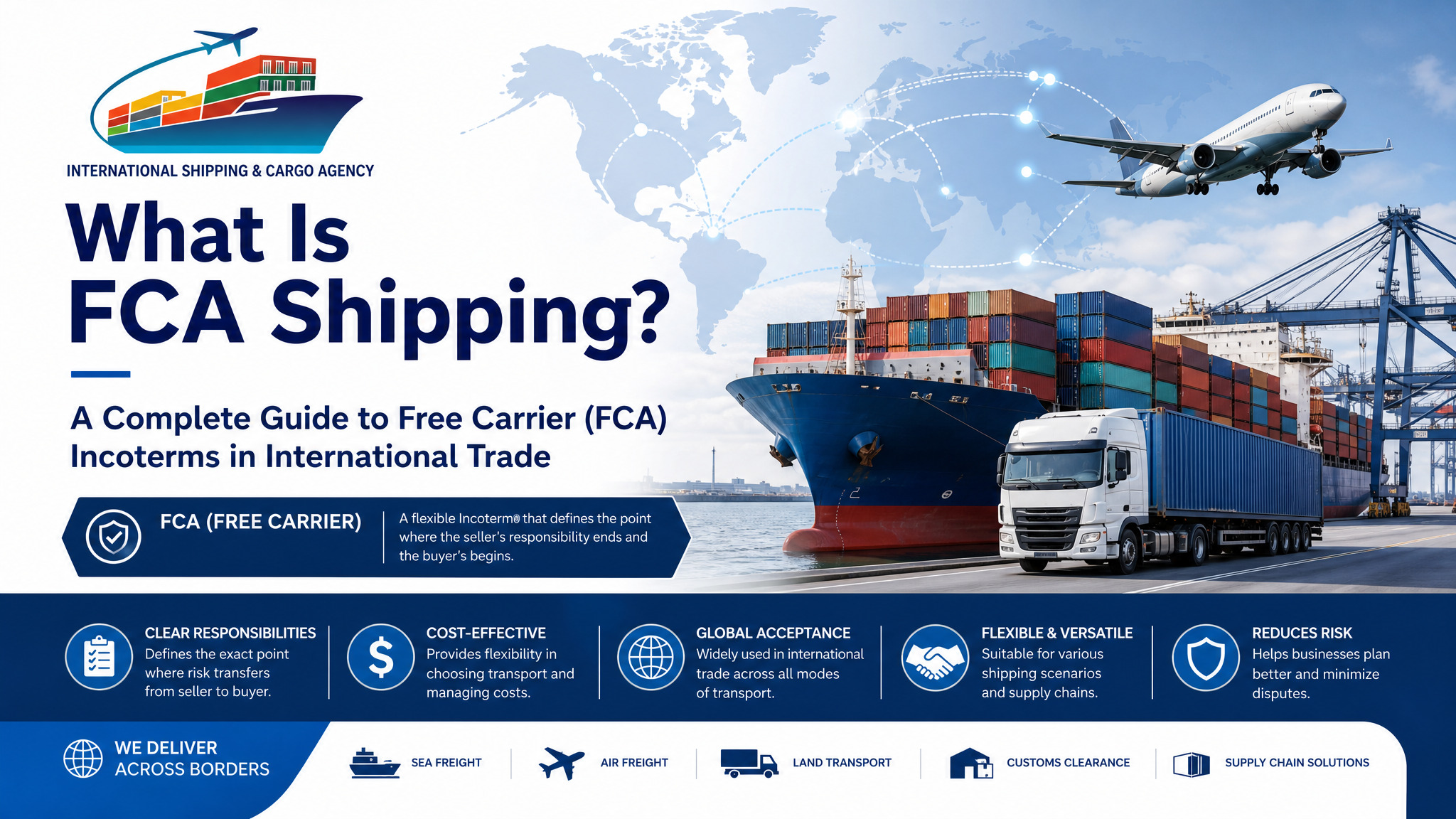
It is important for international business transactions to have well-defined shipping terms. One of the trade terms that is used most often is the FCA Shipping, or Free Carrier. It does not matter whether you are an exporter, importer, manufacturer, or freight forwarder. Knowing about what FCA shipping is can be very helpful for you.
In International Cargo Shipping we assist companies to ship goods from around the world by air cargo and ocean cargo transport. Selecting the proper Incoterm will be an important part of creating your supply chain and FCA shipping can be one of the most logical options for doing so.
This guide will provide information on what is FCA shipping how it operates, buyer and seller obligations, documentation needed, advantages and when using FCA becomes the best mode of shipment.
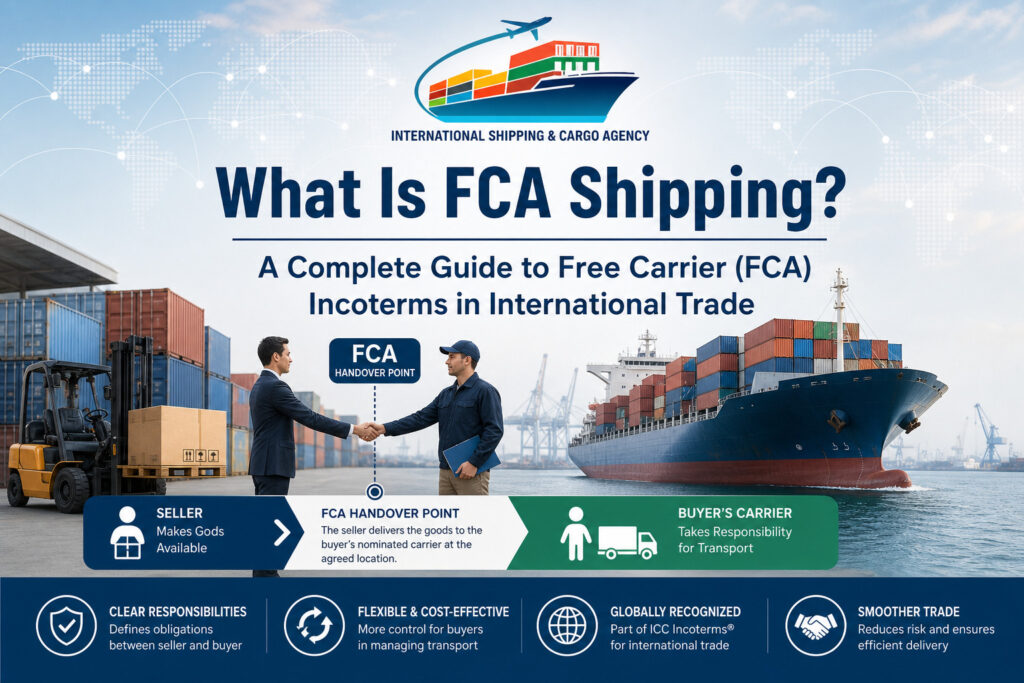
FCA Shipping represents Free Carrier, which is one of the Incoterms used globally and which are published by the International Chamber of Commerce (ICC). It explains the moment when the obligation of delivering the goods by the seller ends as he/she delivers the goods to the carrier selected by the buyer.
Basically, FCA Shipping implies that the seller makes the preparations for shipping, performs the export custom formalities wherever necessary, and delivers the goods to the appointed carrier. After that, all responsibilities and risks move to the buyer.
FCA Shipping is more flexible than many others in the sense that it allows for a delivery point to be either a seller’s warehouse, a freight station, an inland container depot, an airport, or any other location specified by both the parties involved.
Incoterms are international business terms that provide regulations in international business transactions. They outline the responsibilities of both buyers and sellers in international business. FCA Shipping is among the Incoterms that is widely used due to its simplicity
For FCA Shipping, the obligation lies on the seller for the preparation of the goods, proper packaging, export clearance, and delivery to the buyer’s named carrier at the stipulated point.
.After delivery, all transportation, insurance (where required), importation, payment of duty, tax, and final delivery become the buyer’s responsibility.
This ensures there is clarity of responsibility to prevent confusion and potentially expensive disputes arising in international transactions.
Knowledge about the shipping process helps in comprehending the reasons why many exporters and importers choose FCA Shipping.
Both the seller and the buyer come to an agreement regarding FCA Shipping and mention the exact delivery point in the sales contract.
The seller makes or processes the goods, inspects them, packs them safely, and properly marks them as per the export regulations.
All export documentation is prepared by the exporter, which includes commercial invoices, packing list, export declaration, and whatever certificates are required for the destination country.
The seller carries the goods to the agreed place and delivers the same to the buyer’s selected carrier.
Once the carrier takes delivery of the goods, the liability shifts to the buyer, who then handles the international transportation logistics.
It is the buyer who takes care of the arrangement of freight services, clearance of import, inland transport and delivery.
Through carrying out these duties properly, the seller makes sure that the cargo is delivered to the carrier safely and within export laws.
When the cargo arrives at the carrier, then the buyer becomes responsible for the rest of the journey.
It enables customers to have more control over freight charges, choice of transportation company, and delivery schedules.
One of the crucial elements that need to be known when considering FCA shipping is the timing of risk transfer.
Risk is transferred from the seller to the buyer right after the merchandise is delivered to the buyer’s designated transport at the delivery point.
In case the delivery point is the seller’s premises, risk transfers after the loading of the buyer’s designated transport. In case the delivery point is the container terminal or the airport cargo premises, risk transfers after the official receipt of the consignment by the carrier.
Identification of the exact point of delivery in the sales agreement will help avoid misunderstandings.
Exporters often like FCA Shipping since it offers flexibility and transparency in all the steps of shipment. Shippers get more control over the logistics, while sellers complete their obligations at an early stage of delivery.
When the company cooperates with professionals in logistics who deliver goods using air freight, sea freight, and multimodal transport, FCA Shipping works best in providing effective cargo delivery. It is especially suitable for those firms that need to find efficient options for export, yet keep the responsibility divided clearly among the partners.
In the following section of this guide, we will talk about the pros and cons of FCA Shipping, compare it with other Incoterms including FOB, EXW, CIF, and DDP, highlight the necessary shipping documents, give an example, cover common questions, and summarize the guide.
Correct documentation is crucial to facilitate international business dealings. Despite the cargo reaching the destination at the required time, failure in completing or incorrectly filling out the necessary documents could lead to difficulties at the customs office, higher costs or detention of the cargo. Documentation in FCA Shipping is mostly done by the seller.
Common documents used in FCA Shipping include:
Preparation of precise documentation ensures smoother customs clearance with reduced interruptions during the entire transportation process.
Another factor that makes FCA Shipping popular in international business is flexibility and fair distribution of duties. There are several advantages of this service for exporters and importers.
Both parties understand precisely where their liabilities start and end, which minimizes misunderstandings and disagreements.
In contrast to other Incoterms which primarily relate to sea cargo, FCA Shipping is applicable for road, rail, air, sea, and multimodal modes of transport.
The buyer has the choice of choosing the appropriate freight forwarder, mode of shipment, time period, and cost of transportation.
After the cargo reaches the buyer’s nominated carrier, the seller is not liable for any further transportation risks.
The seller is in charge of exporting customs clearance, which makes compliance more convenient prior to departure from the originating country.
In addition to all the benefits offered by FCA shipping, companies should also be aware of its limitations.
Let us consider the scenario where the machinery is exported by an Indian exporter to an organisation in Germany through the mode of transport called FCA Shipping.
In the Sales Contract, the term “FCA Delhi Inland Container Depot” will be mentioned.
Under the FCA Shipping terms, the Indian exporter makes the machinery, packages the machinery in the right way, clears for exports, and delivers the machinery to the carrier nominated by the buyer at the inland container depot.
The moment when the buyer’s nominated carrier takes possession of the cargo, the liability shifts from the Indian exporter to the German importer.
Many companies tend to compare FCA Shipping to FOB since both entail the transfer of responsibility while exporting products or goods.
| FCA Shipping | FOB |
|---|---|
| Suitable for all transport modes (air, sea, road, and rail) | Primarily used for sea and inland waterway transport |
| Risk transfers when goods are handed over to the buyer’s nominated carrier | Risk transfers when goods are loaded onto the vessel |
| Flexible delivery locations (seller’s premises, warehouse, terminal, etc.) | Delivery takes place only at the port of shipment |
| Ideal for containerized cargo | Traditionally used for bulk and conventional sea cargo |
| Seller completes export customs clearance | Seller also completes export customs clearance |
| Offers greater flexibility for modern international shipping | Best suited for traditional ocean freight shipments |
Shipping is more applicable in case of container transport and multimodal logistics.
EXW (Ex Works): The buyer takes the responsibility almost right away at the place of business of the seller, and in many instances even the export customs formalities fall on the shoulders of the buyer.
FCA Shipping: In this scenario, the export formalities must be completed by the seller before the delivery of the goods to the buyer’s nominated carrier
Management of international shipments is achieved through expertise, proper documentation, and dependable logistics. At International Cargo Shipping, we provide all your freight needs so that international shipping becomes easy for you.
We help you achieve safe shipment of your cargo, either through air freight or ocean freight or any other service that you may need for your logistics. We offer all these freight needs for all kinds of businesses.
The importance of knowing what FCA Shipping means cannot be ignored especially by companies that deal in international business. This is because FCA Shipping ensures that everyone is clear on their duties as buyer and seller
Due to its multi-modal nature and ability to allow flexibility in delivery locations, FCA Shipping has emerged as one of the most realistic Incoterms in today’s international business world. No matter whether your products include finished goods, industrial machinery, consumer goods, or commercial freight, choosing the correct shipping term becomes significant in your trading activities.
As you require reliable solutions for international transportation, we at International Cargo Shipping will be happy to assist you in handling all aspects of shipping from logistics to efficient deliveries and advice on the whole process of exports and imports.
FCA Shipping (Free Carrier) is one of the international business terms in Incoterms 2020. The FCA term refers to the delivery of the goods to a carrier nominated by the buyer at the stipulated destination. After that, all the risks pass to the buyer.
For FCA Shipping, the sale includes the loading of the goods, export customs clearance, and delivery of the consignment to the buyer’s carrier. The buyer is liable for the costs of international shipping, import customs clearance, duties, and delivery of the goods.
It is the duty of the seller to clear the exports from the customs before delivering them to the ship that the buyer had selected.
For FCA Shipping, the buyer generally pays for the international shipping, any necessary cargo insurance, import fees, and costs of delivering the goods at the destination point after delivery to the carrier.
This risk is transferred from the seller to the buyer on the delivery of goods to the nominated carrier of the buyer at the place of delivery.
Yes. FCA shipping applies to air shipments, sea shipments, road transport, rail transport, and multimodal transport, making it among the most versatile Incoterms